IBM vs Claude Code: COBOL Modernization
AI has started to weaken IBM’s long-standing mainframe moat by making legacy COBOL systems far easier to analyze, document, and potentially migrate, shifting modernization from impossible in practice to newly feasible.

COBOL has outlived every eulogy written for it. Mainframe panic in the '80s, client-server in the '90s, cloud in the 2010s, and every "modernization" that quietly turned into another support contract. The code stayed. The mainframes stayed. And IBM stayed, collecting rent on the simple fact that no one wanted to figure out what any of it actually did.
That may be changing.
IBM Shares Down ~13% from A Blog Post
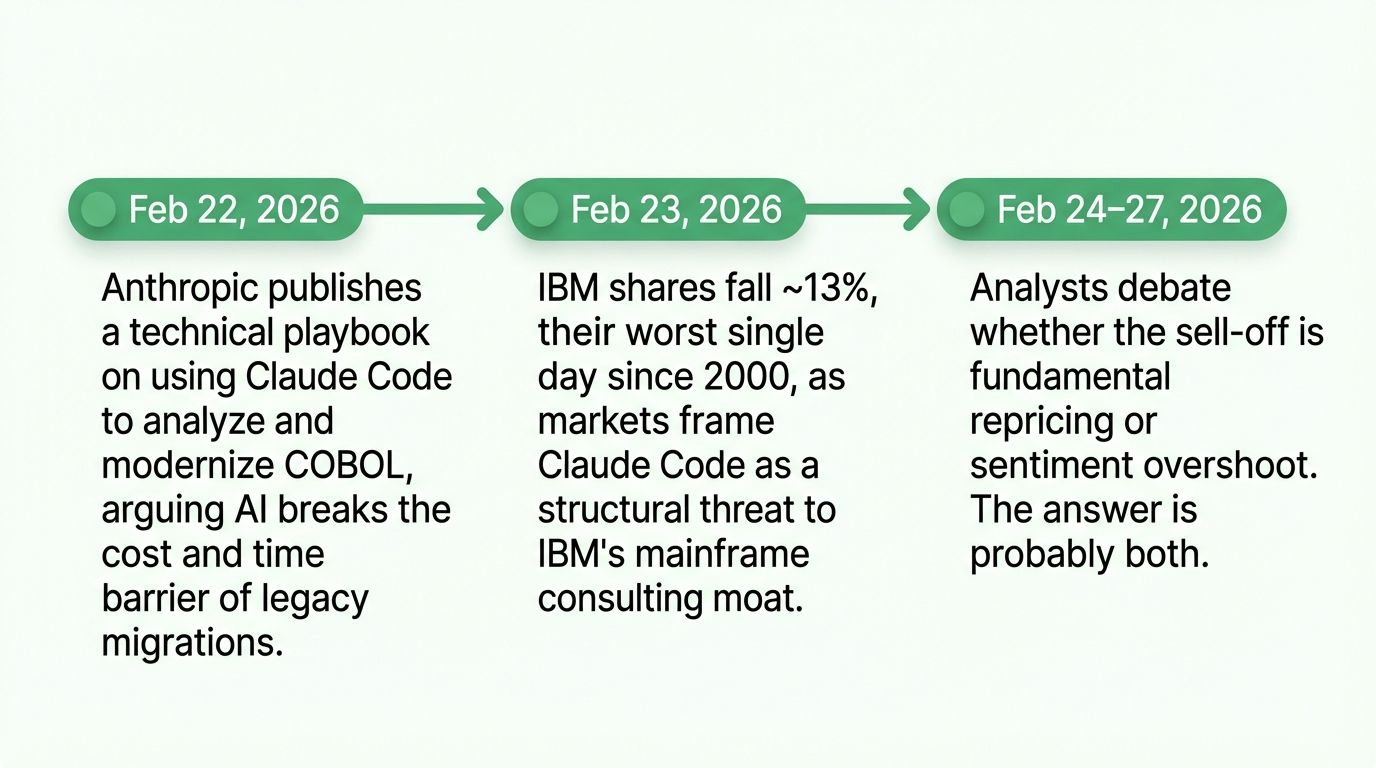
- Feb 22, 2026 – Anthropic publishes a technical playbook on using Claude Code to analyze and modernize COBOL, arguing AI breaks the cost and time barrier of legacy migrations.
- Feb 23, 2026 – IBM shares fall ~13%, their worst single day since 2000, as markets frame Claude Code as a structural threat to IBM's mainframe consulting moat.
- Feb 24–27, 2026 – Analysts debate whether the sell-off is fundamental repricing or sentiment overshoot. The answer is probably both.
A blog post and a technical playbook erased roughly $36B of IBM's market capitalization in 48 hours. To understand why, you need to understand what COBOL really is, and why no one has successfully killed it in 67 years.
AI disruption triggers IBM's largest market drop in decades.
IBM's Real Moat: 800 Billion Lines of Knowledge Debt
COBOL has moved quietly from a historical footnote to the center of one of enterprise technology's most consequential debates. What was once tolerated as legacy infrastructure is now discussed with a strange mix of admiration and embarrassment. That shift says less about nostalgia and more about an uncomfortable realization: COBOL, for all its durability, is starting to limit how far organizations can stretch.
Roughly 800 billion lines of it are still in active use today, running the core of global banking, insurance, government payments, and airline reservations. These systems aren't running COBOL out of inertia. They encode decades of accumulated business logic, interest calculation rules, regulatory compliance routines, claims processing workflows, that's nearly impossible to reconstruct from scratch. The original authors are mostly retired or dead. No one wrote it down anywhere except in the code itself.
This is "knowledge debt." And it's been IBM's most durable competitive advantage, not the mainframe's processing power, not z/OS's reliability, but the sheer impossibility of understanding what you have well enough to leave safely. Every CIO who signed another five-year mainframe contract rather than bet on a risky multi-year migration was paying rent on that debt. IBM collected that rent for decades.
Claude Code is a direct attack on the debt itself.
Claude Code: Automating the Part That Made Migration Impossible
Anthropic's argument is precise: the bottleneck to COBOL modernization isn't budget or willpower. It's the cost of understanding the code in the first place. Their playbook targets exactly that.
It automates the exploration and analysis phases that previously required armies of consultants spending months reading COBOL line by line. Dependency mapping: every entry point, call chain, shared data structure, and implicit coupling across a large estate. Workflow documentation: plain-language descriptions of what business processes the code implements, for stakeholders who can't read COBOL. Risk hot-spotting: surfacing the modules called everywhere, the logic with no tests, the data structures shared across dozens of programs. And assisted translation: proposing equivalent logic in modern languages, wrapped in APIs so legacy and new components can coexist during a phased migration.
The headline claim is that projects taking years can now be done in quarters. Even if that's half true, it changes the build-vs-stay calculation for every CIO who's been quietly revisiting it every three years and always landing on "not yet."
Does Claude Code accelerate progress? Yes. But acceleration without control is just drift at higher speed. The assistance is real, and so is the unpredictability. What looks like leverage often translates into verification overhead, a point Anthropic's playbook, written with a marketer's confidence, quietly skips past.
IBM Keeps You on Z - Claude Code Lets You Leave
The strategic gap here is worth being precise about.
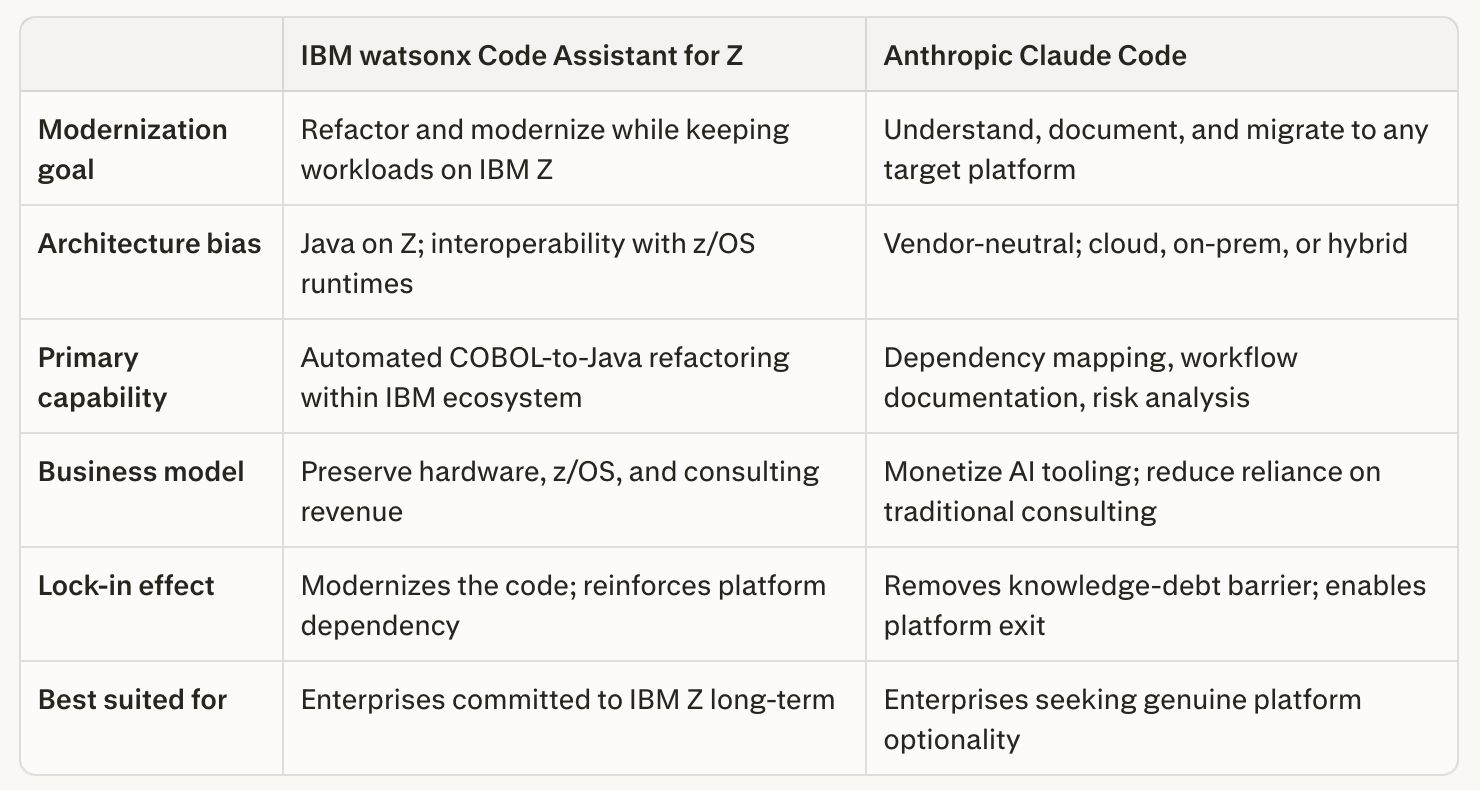
IBM's play is "modernize, but stay on Z." watsonx Code Assistant for Z maps COBOL and PL/I, extracts business rules, refactors into modular services, and generates Java that runs tightly on IBM Z runtimes. The tooling is genuinely capable. But the architecture bias is explicit: the happy path leads to "modernized Java on Z," not "modernized and re-platformed to Azure." IBM's revenue model, hardware, z/OS licenses, high-margin consulting, depends on clients staying anchored to its stack.
Claude Code's play is vendor-neutral by design. It doesn't assume IBM Z as the destination. It says: understand your estate deeply, document it thoroughly, then choose where to run the modernized version. Any cloud. Any runtime. Any architecture. That's not incidental. It's the entire threat.
The moat IBM maintained was economic, not technical. Migration was too expensive and risky to be worth attempting. Claude Code doesn't make the mainframe technically obsolete. It makes staying on it a choice rather than a necessity. For IBM's pricing power, that distinction is everything.
Claude Code shifts mainframe use from necessity to true choice.
Three Sharpest Counters: Why This Isn't a Clean Kill
The industry has a habit of going after the wrong suspect. It's not code complexity that derails modernization efforts. It's what happens after the celebratory proof-of-concept. The real culprit is a workflow that chases momentum first and correctness later, then pays the price when a mis-migrated rule misprices ten thousand loans.
Three specific counters deserve weight.
AI on real COBOL is messier. Independent tests on production-grade COBOL show real gaps in Claude Code's rule extraction: missing critical logic, high variance across runs, vague explanations for complex edge cases. Most real-world COBOL is proprietary and was never part of any public training corpus. That's a structural ceiling Anthropic's playbook doesn't address.
Code translation is the easy part. Understanding and refactoring COBOL is a small fraction of modernization risk. Data migration, integration with surrounding systems, throughput and failover parity, and decades of embedded operational assumptions are where projects actually fail. Claude Code is almost entirely about code analysis, necessary, but not sufficient.
Regulated industries need more than "the AI said it's equivalent." In banking, insurance, and government, behavioral equivalence must be proved to regulators, audit trails maintained, and identical outputs demonstrated for every edge case ever seen in production. No AI tool currently provides that end to end.
The Window to Modernize Has Never Been Wider
For the first time in a generation, the economics of COBOL modernization have shifted in the customer's favor. The knowledge-debt barrier that kept organizations trapped, and kept IBM's renewal conversations one-sided, is crumbling. AI tooling hasn't solved every problem, but it's solved the hardest one: getting a clear enough picture of what you actually have to make a rational decision about where to go next.
There's no universal fix, only disciplined application. Organizations that act now get ahead of the curve: lower AI tooling costs, a growing pool of modern-stack engineers, and the strategic leverage of platform optionality at every future negotiating table. Those that wait will find the window narrowing, not because the technology disappears, but because competitors who moved first will have already converted years of operational debt into cloud-native agility.
The real transformation isn't technological. It's psychological. What once inspired institutional paralysis can, with the right discipline, become simply part of the operating rhythm.